
How to Search Tallahatchie County Property Records
Start with whatever key you already hold. An address will pinpoint a parcel fast. So will a point on the MARIS Tallahatchie parcel layer. An owner name works too, though it may pull up several assessed parcels at once. The parcel number is the best link of all. It ties the GIS release to the tax roll, the deed reference, and the recorded plat. Write down both the situs and the mailing address. The two do not always match. Treat MARIS as a discovery tool. It is not a live county assessment card or any kind of title guarantee. Gather identifiers there first. Then verify the current roll with the Tax Assessor/Collector. Confirm title through the Chancery Clerk. Parcel lines on a screen never substitute for a survey.
- Locate the tract by address, owner, or map point in MARIS and record the parcel number.
- Determine whether the land file belongs to the Charleston First District or Sumner Second District.
- Ask the Tax Assessor/Collector to confirm the current owner, value, classification, and homestead status.
- Use the deed and plat references to request the recorded instruments from the appropriate Chancery Clerk counter.
- Order a certified copy when evidence is needed; use a written Public Records Act request for retrievable material not otherwise available.
Tallahatchie County Property Records Offices
Mississippi keeps its land records with the Chancery Clerk rather than a separately titled recorder. Tallahatchie adds a wrinkle: its two courthouse counters serve different judicial districts. The elected Tax Assessor/Collector holds the live assessment and collection records. Taxes inside Charleston and Sumner may call for a separate municipal inquiry.
Chancery Clerk, First District
150 Court Square
Charleston, MS 38921
662-647-5551
Chancery Clerk, Second District
100 Court Street
Sumner, MS 38957
662-375-8731
Tax Assessor/Collector
County offices serve both districts
Confirm the correct counter before visiting
Dorothy M. Martin, Assessor/Collector
Why Tallahatchie County Has Two Land-Record Counters
The county's two-counter split is operational, not decorative. Charleston serves as the First Judicial District seat. Sumner holds the Second. Send a request to the wrong courthouse and you can stall a deed, lien, plat, probate, or tax-sale search for weeks. Whenever the parcel's location points to one district, label your correspondence "First Judicial District" or "Second Judicial District" plainly, and include the parcel number, legal description, party names, and an approximate recording date. When the district is unclear, begin with the Assessor/Collector or MARIS geometry. Ask the clerk to confirm jurisdiction before you order copies. The LTAMS district pages list land-index categories. Neither counter posts a public online land-record search link. The split reaches beyond deeds. A chancery case, will book, section index, lis pendens entry, foreclosure notice, or tax-sale record may live in a district file even when a statewide portal hints at it. Never send a blanket request for "everything on an address." Name each record series and give a date span so staff can locate the right index and shelf.
The MARIS Parcel Release Is Tallahatchie's Online Starting Point
The statewide layer exposes fields a searcher can actually use. Among them are PARNO, OWNNAME, SITEADD, the mailing address, subdivision name, deed and plat references, the legal description, tax year, land value, improvement value, section, township, range, and coordinates. The ArcGIS query form accepts attribute or geometry searches alike. Results come back as JSON or GeoJSON.
| Field group | Use in a county search | Important limit |
|---|---|---|
| Address and owner | Find candidate parcels and distinguish situs from mailing data | Names may lag a recent deed |
| Parcel and legal description | Carry stable identifiers to county offices | A description still needs the recorded instrument |
| Deed and plat references | Point the clerk toward a book, page, or map record | They are reference fields, not document images |
| Tax-year values | Compare land, improvements, and total for the stated year | Not a live appraisal or sale estimate |
Types of Tallahatchie County Property Records
Each record set answers a different question. A deed names the owner of record. The tax roll shows what the assessor bills.
Reconcile them instead of trusting one owner string or map feature as the full property history.
| Record Type | What It Documents | Kept By | Access |
|---|---|---|---|
| Deeds | Conveyances, parties, legal descriptions, and recording references | Chancery Clerk | District courthouse; certified copies by request |
| Deeds of trust and liens | Recorded security interests, releases, and encumbrances | Chancery Clerk; SOS for UCC/state liens | Office records and relevant state search |
| Tax and assessment | Classification, values, homestead, bill and delinquency information | Tax Assessor/Collector | Office request; no official county portal located |
| Plats and parcels | Lot/block or metes-and-bounds context and mapped geometry | Chancery Clerk and MARIS | Free state layer; recorded plat from clerk |
| Permit and zoning files | Municipal approvals, inspections, variances, and ordinances if held | Relevant municipality | Direct request; no city search database located |
Pick the record that fits the question. A transfer question points to Tallahatchie County deed records, a billing question to property tax records, and a boundary question to the recorded plat backed by a survey.
Deeds, Plats and Liens Are Primarily an Offline Search
Tallahatchie County publishes no online deed index or plat image portal. The Chancery Clerk holds those books. Bring the parcel's deed reference, legal description, owner name variants, and district. Then request the latest deed, earlier grantor and grantee entries, deeds of trust, releases, lis pendens, liens, and any cited map or plat book. The LTAMS recording guide lays out statewide document and copy requirements. Confirm the actual charge and delivery method with the district office before ordering anything.
A grantor conveys the interest. A grantee receives it. To rebuild a chain of title, start with the current deed. Copy down its grantor and prior reference. Then work the same steps backward through the books. Watch for spelling variants, initials, estate or heirs wording, trust names, and business suffixes. These hide entries that belong in the chain. Remember that a deed of trust is not itself an ownership transfer. Match every release to the instrument it satisfies.
Tallahatchie Tax Values Use Mississippi's Classification Rules
Mississippi DOR describes the tax formula in plain terms. True value times the assessment ratio times millage produces the bill. Class I owner-occupied single-family real property carries a 10 percent ratio. Class II covers other real property at 15 percent. That means a deed's consideration, a MARIS total value, an assessed value, and a tax bill are four different figures. Comparing them directly will mislead you.
Homestead applicants generally must own and occupy the home on January 1. They must also file between January 1 and April 1. Check the current DOR homestead guidance. Ask the county office whether a change in ownership or use triggers a new application.
For a full tax inquiry, request the tax year, true or appraised value, and assessed value. Also request the property class, millage, exemptions, amount billed, and payments. Include any delinquency or sale status. Charleston and Sumner each collect their own municipal taxes, per the district directory. So a county answer may not cover a city balance. Match every figure to its custodian and year before comparing parcels.
Older Tallahatchie Land Books Survive in Several Collections
The official MDAH Tallahatchie finding aid previews the archival route:
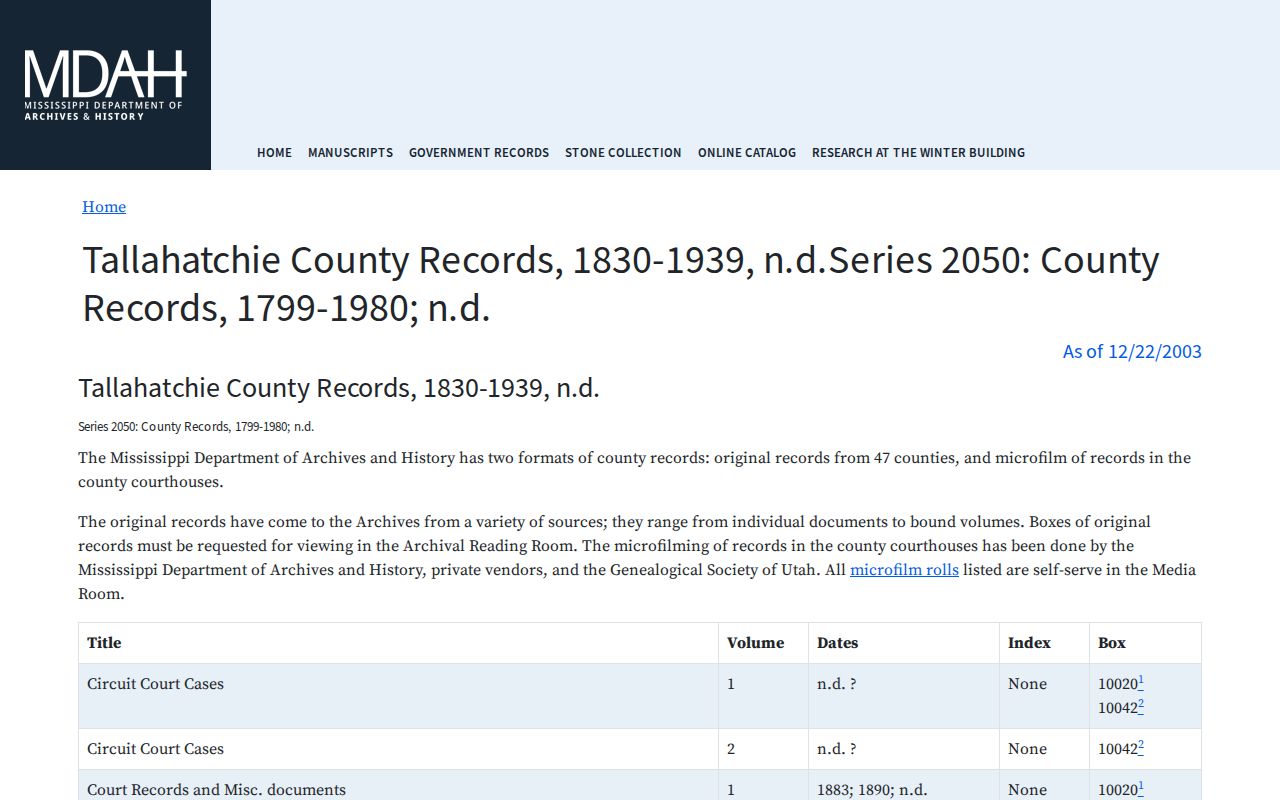
Tallahatchie deed research does not end at the courthouse. The Mississippi Department of Archives and History finding aid reaches Tallahatchie County property records from 1830 through 1939, and its pre-1920 inventory can be searched by county, title, date, volume, office, and district. FamilySearch catalogs transcribed deed books, original land entries, and wills. Image coverage varies. These archives matter when a courthouse book has gone missing or when an old legal description leans on roads and community names that no longer exist.
Record loss never proves a transfer failed. A copy often survives in a derivative source. Test the tax rolls, probate files, court minutes, land-entry papers, later deeds that recite an earlier conveyance, and recorded plats. Keep the archive call number, microfilm number, volume, and page beside any transcription. That citation lets the district clerk, or another deed researcher, retrace the conclusion.
Court Cases Can Change a Tallahatchie Property Trail
A parcel release that shows no seller can leave a gap in the chain. Foreclosure, quiet-title, partition, and probate matters in chancery court often explain the change. Mississippi Electronic Court System subscribers reach MEC remotely. Courthouse terminals offer free electronic viewing under system rules. Paper files and certified copies come from the district clerk.
Registering for MEC is only an account route. It does not mean every Tallahatchie file is searchable from home. Start with party names, case type, an approximate filing year, and the judicial district. At the courthouse, note the docket number and any recording reference. Also note the pleadings describing the land and the judgment date. Then return to the Chancery Clerk's land index. See whether the decree, commissioner's deed, or other instrument was recorded against the parcel.
Use a Written Request When Tallahatchie Records Are Not Online
Written requests fill the gap when Tallahatchie County records sit outside any portal. The Mississippi Public Records Act of 1983 backs requests for identifiable, nonexempt records. County or municipal records both qualify. Describe the parcel, district, record type, date range, and preferred electronic format. Ask for an estimate before copies are made. Request a written explanation if anything is withheld. The Mississippi Ethics Commission overview explains the Act's costs, timing, and remedies.
Route each request by custodian. Land instruments go to the Chancery Clerk, live assessment and collection questions to the Assessor/Collector. Court files belong with the right clerk. Municipal actions go to Charleston, Sumner, or Tutwiler. Include contact information, and ask whether inspection costs less than copying. A focused request is easier to route. It keeps an office from reading a parcel question as a demand for legal research.
Local Maps and Newspapers Add Context, Not Title
Maps and newspapers enrich a Tallahatchie property search. They cannot prove title. MDAH preserves Tallahatchie maps across many years and lists eleven National Register properties and sites. The Tallahatchie County Library adds reference help, newspapers, databases, scanning, and interlibrary services. Such tools can tie an old road, landmark, fire, or family name to a clue. That clue can lead to the right parcel. A clipping or historic nomination still cannot establish present ownership. Carry every clue back to the deed, the plat, and the current tax roll.
Prepare before you call. Write down former owner names. Add approximate dates, community names, road variants, book references, and both judicial districts. Ask about newspapers, map series, directories, and microfilm runs. Label any scanned clipping or historic map as context. The recorded instrument and the current custodian's response remain the sources for legal and present-day facts.
What Tallahatchie County Property Records Can and Cannot Tell You
Tallahatchie County property records can answer a lot. A property search may surface the owner of record, assessed values, legal-description clues, recorded transfers, liens, and mapped parcel geometry. The limits matter just as much. These records cannot confirm that every interest has been found, place a boundary on the ground, guarantee that an address sits inside a municipality, or replace a current market appraisal.
Lawful use. Use records for legitimate property research, purchase diligence, estate work, boundary questions, and civic transparency. A records search does not replace a title professional or licensed surveyor, and owner information must never be used to stalk, harass, threaten, or harm anyone.