
Trace Tallahatchie Former Owners Backward
Every former-owner chain begins with the newest deed. From there you move back one transfer at a time. Each row of a worksheet should preserve the date, the parties, the deed type, and the exact reference. That reference may be a book, page, or instrument number. Treat the table as a working worksheet for your own Tallahatchie County parcel. It is not a claim about any property.
| Transfer date | Grantor to grantee | Deed type | Book/page |
|---|---|---|---|
| Newest recording date | Prior owner to current grantee | As indexed | Copy exactly |
| Earlier recording date | Earlier grantor to prior owner | As indexed | Copy exactly |
| Repeat backward | Earlier link to later link | Warranty, quitclaim, fiduciary, or other | Keep district with citation |
The grantor conveyed the interest. The grantee received it. Warranty and quitclaim deeds carry different promises. Yet either can form a link in Tallahatchie County deed records. A chain of title is simply the ordered run of transfers for the same land. A reverse index is arranged from the grantee side. It shows when a former owner first acquired the tract.
Choose Tallahatchie's Historic District
Tallahatchie County's property records split along two judicial districts. First District records live in Charleston. Second District records sit in Sumner. The LTAMS First District page and its Second District companion list the deed, deed-of-trust, substitution, sectional, plat, lien, lis pendens, chancery, and will indexes that clerks still maintain. Neither page offers a public land-record web search, so the indexes themselves are the working tool for a parcel search that reaches back through generations of owners of record.
Tell the Chancery Clerk which district held your parcel during the span you are tracing. First District sits at 150 Court Square, Charleston, 662-647-5551. Second District is at 100 Court Street, Sumner, 662-375-8731. Counter access, a courthouse terminal, phone guidance, mail requests, and a written records request remain the practical channels for working the deed records and tax roll history in person.
Reconstruct Tallahatchie's Deed Chain
Start with today's parcel identity and its newest confirmed conveyance. A street address can guide discovery. The legal description, section-township-range, lot and block, or tract text keeps the Tallahatchie County chain on the same land when roads and parcel numbers change.
- Find the current grantee's acquiring deed and copy its full reference.
- Read the grantor, date, deed type, and legal description.
- Search that grantor as an earlier grantee for the same tract.
- Repeat, checking name variants, estates, trusts, and court transfers.
- Move into the district deed books or archival film when the current index ends.
- Grantor and grantee
- The conveying party and receiving party named in an instrument.
- Chain of title
- The linked sequence of recorded transfers for the same land.
- Reverse index
- An index organized from the receiving-party side.
- Quitclaim and warranty
- Deed forms with different promises, both of which may carry a transfer.
First District Owners From 1833
The FamilySearch catalog lists First District deed records from 1833 through 1889. An index runs from 1835 through 1889. Catalog ranges are firm. Not every image is open online, and account, film, and image availability can vary. The same catalog entry is where Tallahatchie County deed records for each district are located.
Search by place, surname, title, author, subject, or keyword. Filters matter. Catalog fields also carry call number, film, fiche, or image-group number plus an online-availability flag, so preserve the catalog title and district when asking the courthouse or archive for the underlying book.
Second District Owners Through 1902
FamilySearch describes transcribed Second District deed books from 1837 through 1902, plus original land-entry volumes spanning 1839 to 1857 and 1840 to 1907. Will books run 1830 to 1925. Land entries follow township and range. Today's parcel number was never their guide. Those collections can push a Tallahatchie County deed chain past a modern index. Read them beside the deed's legal description, never as a name-only match. A will or estate record often explains why a later deed began with heirs, an administrator, or an executor instead of a familiar seller.
Sumner Fires Changed the Trail
Tallahatchie County formed in 1833, and two judicial districts arrived in 1902. Sumner's first courthouse went up in 1903. It burned in 1908. Historical accounts report another fire, with record loss, a year later. A break may reflect loss, not a missing transfer. Never fill the gap with a guess. Instead, record which substitutes were used: transcribed FamilySearch books, an MDAH series, tax-sale material, probate files, maps, newspaper notices, or a later deed recital. A later instrument sometimes restates an older Tallahatchie County chain whose original deed book did not survive.
MDAH Extends Tallahatchie Ownership Research
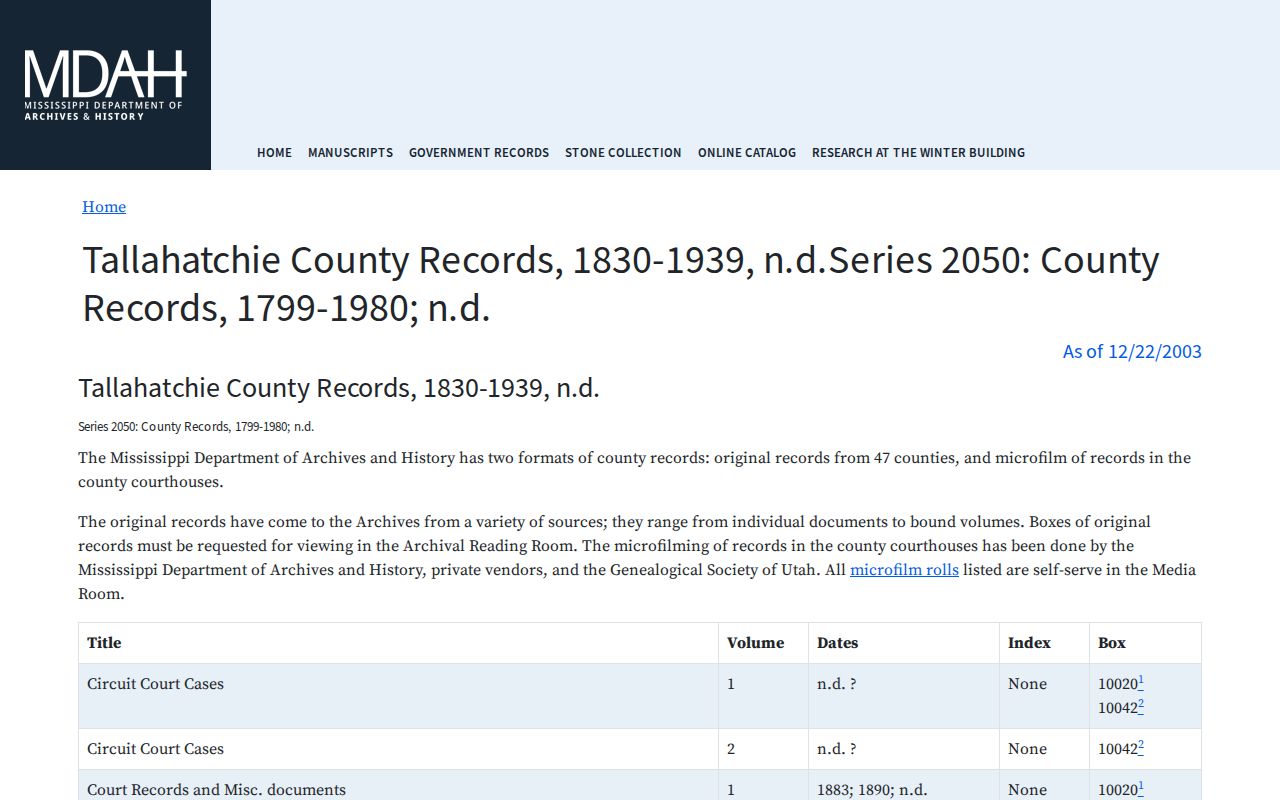
The MDAH Tallahatchie finding aid covers county records from 1830 through 1939. It spans originals and microfilm. Holdings include estate administration, a township-range chart, an 1883 property list, court material, and historic tax-sale records. The finding aid groups everything by record series.
The captured pre-1920 inventory shows county, title, dates, volume, office, and district filters.
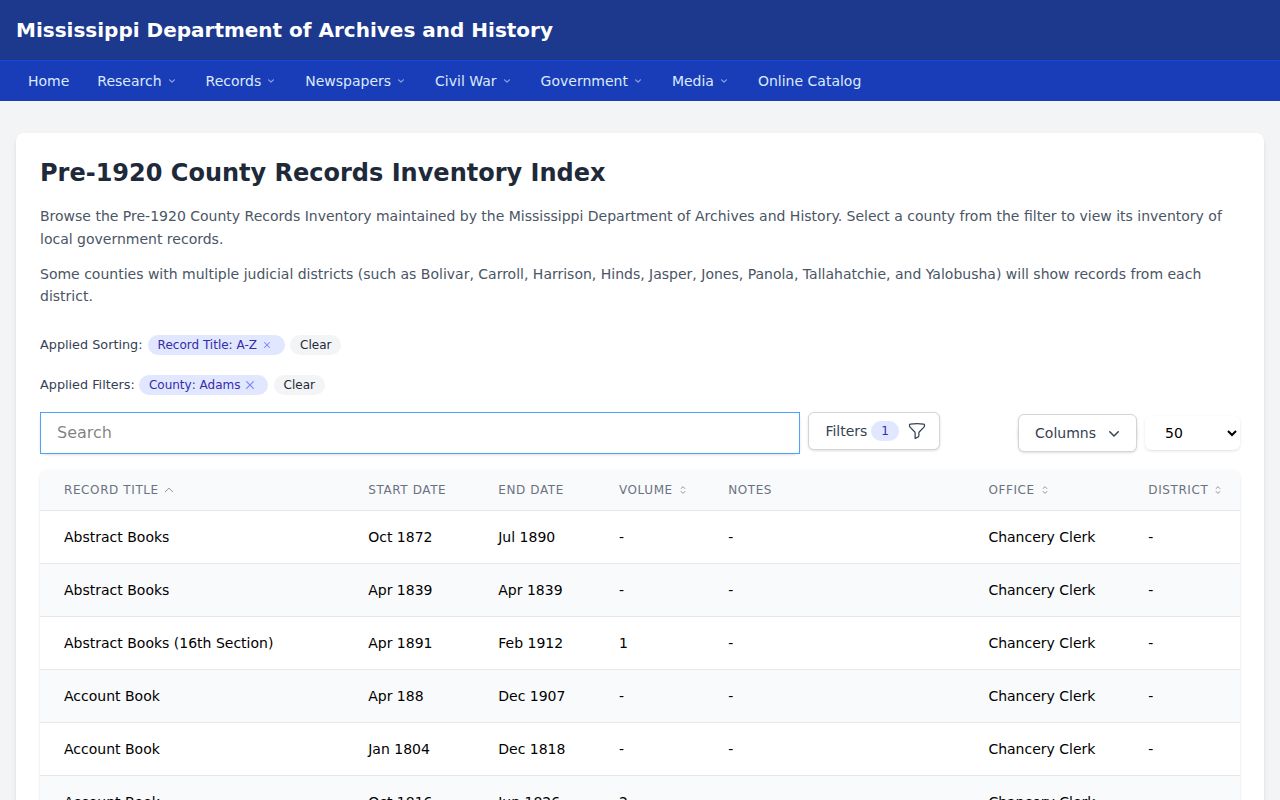
Ask for one precise series, volume, folder, or reel. Vague requests stall. Terms like abstract book, sectional index, tax sale, letters of administration, deed book, and map may lead to separate collections, so use the filters to keep your request tied to the right Tallahatchie County district and era.
Maps Preserve Tallahatchie Place Clues
MDAH holds county maps dated 1971 through 2011. Older town-map runs cover Charleston, Sumner, Webb, and Glendora. A historic map can expose a road-name change, town growth, or the community behind an old legal description. Maps give context, not proof of transfer. Compare the old map with section, township, range, subdivision, lot, plat, acreage, and a stable landmark. Then return to the deed book, because a tax polygon or historic map never replaces a recorded Tallahatchie County survey.
Estate and Tax-Sale Owners
A tidy grantor-to-grantee chain sometimes stalls in Tallahatchie County property records. Ownership may have moved through probate instead. It may also have passed by tax sale, levee transaction, partition, or court order. Local material for these moments is rich. Tallahatchie sources hold will books and chancery files. They also hold letters of administration and early tax-sale entries from 1848, 1849, and 1861.
Tallahatchie Ownership Time Depth
Follow the estate or court record to the deed that came later. Never force an ordinary sale into the gap to close it. Note the fiduciary role. Note the authority the transfer cited, whether an administrator's deed, a decree, or a tax deed. Your written result should say where the chain was bridged. It should also say which original record simply is not there.
Online-cutoff caution. Older former owners are found through courthouse books, FamilySearch catalog leads, MDAH originals, and microfilm, not a claimed public online start year.
Tallahatchie County publishes no online deed index. So there is no stated cutoff year for digital property records. The historic trail in the deed records runs deep, though. Will books begin in 1830. First District deeds begin in 1833. Second District transcribed deeds date to 1837. Land entries start in 1839, and the MDAH county finding aid covers 1830 through 1939.
Lawful use. Trace former owners for house history, title work, estate research, or purchase diligence, never to track or harass a living person.
Tracing ownership back through Tallahatchie County property records works best when you treat it as a timeline of many transfers rather than a search for one paper. For a single certified instrument, take the Tallahatchie deed-records route instead.